2009. december 8., kedd

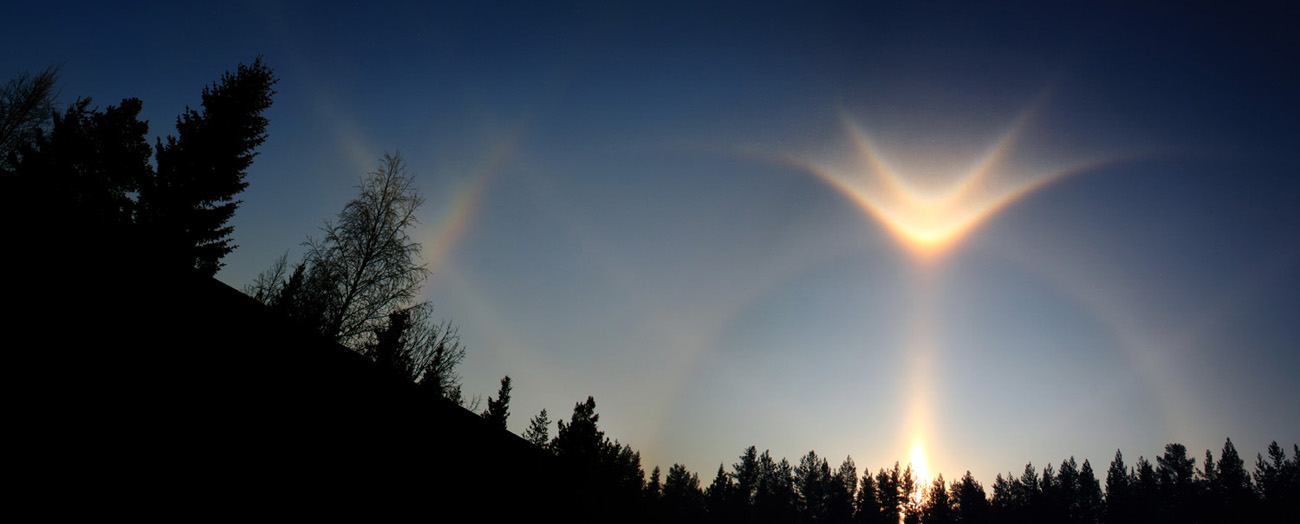
When you see Moilanen arc - look below the sun!

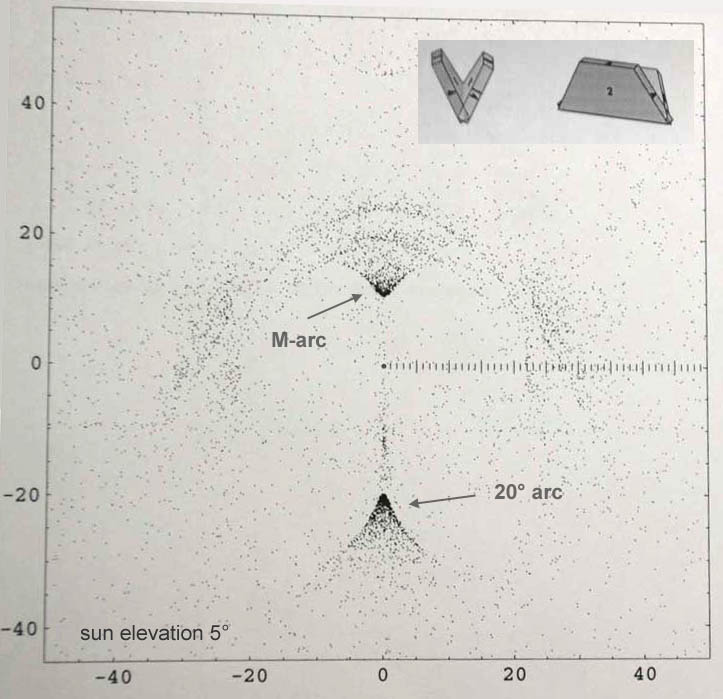
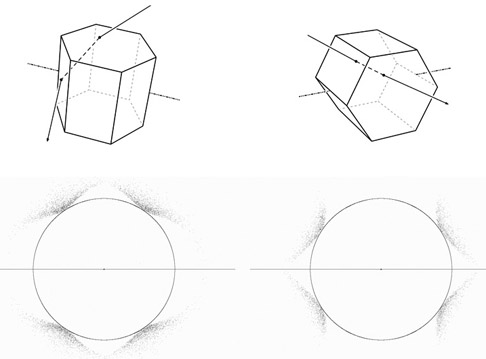
Several of us have been talking about a possible explanation for M-arcs. The responsible crystals are twinned trapezoidal plates that have what might be called restricted Lowitz orientations. The crystals perform rotational oscillations about a horizontal axis, with the equilibrium orientation having the vee opening directly upward, as in the left hand crystal.

All of us are more or less skeptical about this explanation, but we think it deserves testing. The model predicts a strong lower 20° arc. We are asking that, if you are lucky enough to see an M-arc, then please put yourself in an elevated position and look for the lower 20° arc. There are other observing suggestions as well, but I think I will leave them for the blog.

(Walt Tape)

2009. december 7., hétfő

Bright sunvex Parry arc

Sometimes halo display actually comes to your door step. On October 14th Toivo Säkkinen got out of his house in Kuusamo to feed the birds. Instead, he decided to photograph the halos first. This must be one of the earliest diamond dusts in Finland.

2009. december 5., szombat

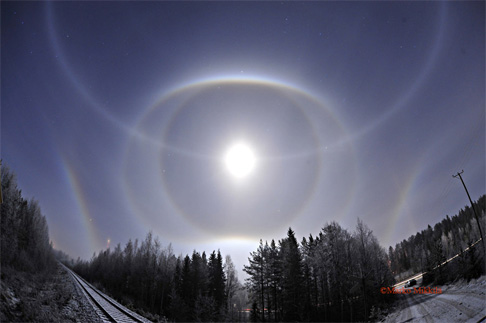
Lunar halo complex in Sotkamo, Finland

In the morning of 3rd Decemeber Marko Mikkilä packed his halo gear and drove 200 kilometers to Sotkamo, where snow guns were running at the local ski resort. Once he arrived, there was fog, but it was mainly water fog and only occasional poor halos were seen.

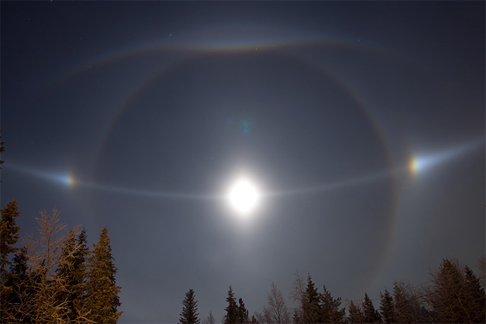
However, when darkness fell, the water fog cleared off and diamond dust started kicking in as the air got colder. In the beginning the moon showed no good halos but spotlight gave a reasonable display ( 1 ). Later also the moon halos catched on, as is seen above. Click on the image for more photos.

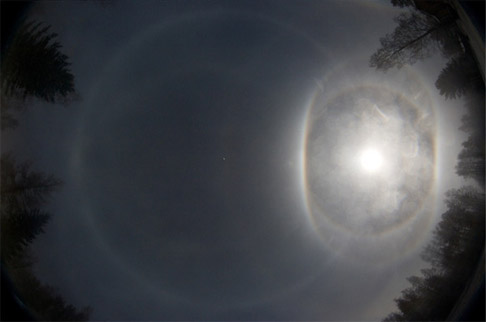
Simulation of the display ( 2 ) needed slightly flattened columns to get the subhelic arc intensity right. With any other crystal shapes, the part opposite to the moon where this halo is tangent to Tricker arc, was not visible. Intuitively those flattened crystals would take Parry orientation, so it looks like again we are not really understading it. Same effect was also present in the great Himos display last winter ( 3 ).

After midnight Mikkilä headed home because the high clouds in the background were becoming too disturbing. All together the halo hunting trip took 600-700 km of driving. Looking at the results it was definitely worth it. See also the photos by Jari Luomanen from the same night at the Sappee ski resort, and be sure to read his insightful description of the diamond dust formation on the right ( 4 ).

2009. december 3., csütörtök

Halo display in Himos on the evening of 2nd Dec 2009

Yesterday evening I was with my HID-lamp in Himos ski resort, Jämsä, looking for some haloes. It was full moon, which is no good combination with the lamp, but I managed to get some lamp photos when moon was behind clouds. But nothing special wasn't shown. After driving a few hours around ski resort I managed to find a place where I got some good moon haloes. Unfortunately I didn't notice right away that my camera lens was starting to freeze which is why some of my pictures are a bit blurred. See more photos here ( 1 ).

Arctowski's book of optical phenomena in the Antarctic

In 10 March 1897, a scientific research expedition ship Belgica got stuck in ice in the Antarctic waters. On board the ship was a Polish scientist Henryk Arctowski, who made notes of optical phenomena during the ship's one year and 3500 kilometer drift with the ice. His book of these observations, "Phenomenes Optiques de l'atmosphere", is now online ( 1 ).

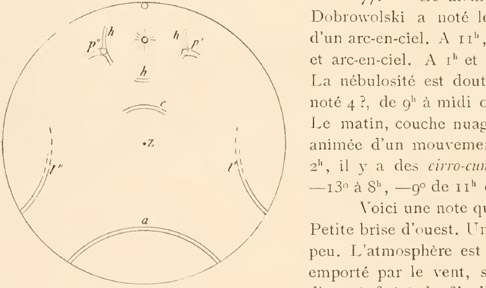
Shown above is his most well known halo observation, the one with the "Arctowski arcs" that in the drawing rise from the horizon at about 120° from the sun. There are also other peculiarities, for Arctowski reports the patches of h to be 26 - not 22 - degree radius from the sun and the circumzenith arc distance from the zenith to be 28-29 degrees, which is probably more than it should be at the observation's sun elevation.

But if we leave the measurements aside and look at the drawing, the sunside of the sky looks pretty ordinary. The Arctowski arcs, which he writes as being faint, could be misplaced 46° infralateral arcs. And the rainbow in the opposite sky could be a fogbow. So, nothing extraordinary there, except maybe for the fogbow, that still has not been captured on film with halos in naturally lighted conditions.

Any French speaking readers here who could translate Arctowski's account of the display (PDF page 40-41)? It looks like he had made some interesting notes on the halos showing up in nearby crystals. I can add it here.

2009. november 30., hétfő

Moon diamond dust halos in Lappland

This splendid display was seen last night in Sirkka, Finland. The photographer, Timo Veijalainen, tells the display lasted for about an hour after he noticed it and that the temperature was close to -10° C. Sirkka is a settlement right next to Levi ski center, from which snow guns this must have originated. Click above to see more images on the photographer's site and check also what Les Cowley says about the halos ( 1 ).

2009. november 25., szerda

46° contact arc

46° contact arc was suggested theoretically in 1980 by Robert Greenler. Halo enthusiast have since kept the 46° contact arc in mind, but it was not until 2006 that first photos surfaced when a well developed diamond dust display was seen in Muonio, Finland ( 1 ). Second, slightly less obvious case was photographed in spotlight beam last winter in Riihimäki, Finland ( 2 ).

46° contact arc is formed by Lowitz-oriented crystals and it divides in three components. One of the components comes from raypaths that pass through prism face that is parallel to the Lowitz axis. This component is found straight above and below the sun. In spinning crystals light ray can enter both prism and basal face (1-3 / 3-1 type).

Two other components (shown above for 0° sun elevation) are formed by raypaths that pass through prism face that is at an oblique angle to the Lowitz axis. They are distinguished by the ray either entering (4-1 type) or exiting (1-4 type) this face. These arcs are not in the solar vertical and their position changes with sun elevation.

See simulations (Jukka Ruoskanen's software) where 46° contact arc components are shown from spinning crystals for different sun elevations ( 3 - 4 ). Normally, though, halos from Lowitz orientation are not indicating spinning-type orientation distribution. Rather, we will see 46° contact arc from either plate-Lowitz or Parry-Lowitz orientation ( 5 ).

On most sun elevations 46° contact arc components conform deceptively the curvature of the 46° halo. Circumzenith arc also can overlap upper components. Because of the delicate form of 46° contact arc, it may be very difficult to observe in high clouds. Chances are certainly better in uniform diamond dust.