A következő címkéjű bejegyzések mutatása: Historical. Összes bejegyzés megjelenítése

2009. december 3., csütörtök

Arctowski's book of optical phenomena in the Antarctic

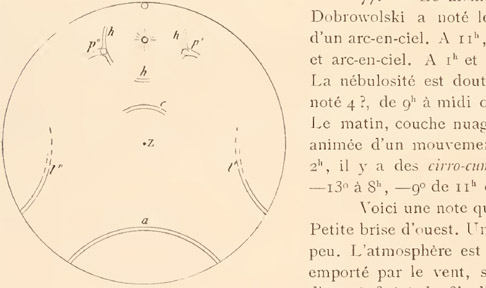
In 10 March 1897, a scientific research expedition ship Belgica got stuck in ice in the Antarctic waters. On board the ship was a Polish scientist Henryk Arctowski, who made notes of optical phenomena during the ship's one year and 3500 kilometer drift with the ice. His book of these observations, "Phenomenes Optiques de l'atmosphere", is now online ( 1 ).

Shown above is his most well known halo observation, the one with the "Arctowski arcs" that in the drawing rise from the horizon at about 120° from the sun. There are also other peculiarities, for Arctowski reports the patches of h to be 26 - not 22 - degree radius from the sun and the circumzenith arc distance from the zenith to be 28-29 degrees, which is probably more than it should be at the observation's sun elevation.

But if we leave the measurements aside and look at the drawing, the sunside of the sky looks pretty ordinary. The Arctowski arcs, which he writes as being faint, could be misplaced 46° infralateral arcs. And the rainbow in the opposite sky could be a fogbow. So, nothing extraordinary there, except maybe for the fogbow, that still has not been captured on film with halos in naturally lighted conditions.

Any French speaking readers here who could translate Arctowski's account of the display (PDF page 40-41)? It looks like he had made some interesting notes on the halos showing up in nearby crystals. I can add it here.

2008. június 2., hétfő

What's missing from Parry's drawing?

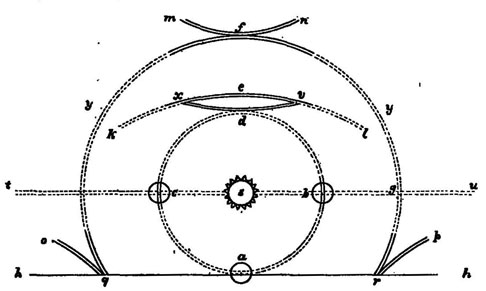
The famous halo drawing by explorers William Edvard Parry and Edward Sabine does not contain all halos they observed. These missing features are described in their account of the display. First, the parhelic circle was complete with anthelion:

"r p, q o, arches of large circles, very strongly prismatic, which could
only be traced to p and o; but on that part of the horizontal circle
t u, which was directly opposite to the sun, there appeared a confused
white light, which had occasionally the appearance of being caused
by the intersection of large arches coinciding with a prolongation of
r p, and q o."


Possibly there were traces of the white arcs from column crystals, which caused the occasional impression of anthelion being caused by the extension of infralateral arcs (r p, q o). At least later these faint white arcs became so clear as to make further note of them:

"At 90° from the sun, on each side of it, and at an altitude of
30° to 50°, there now appeared also a very faint arch of white light,
which sometimes seemed to form a part of the circles q o, r p; and
sometimes we thought they turned the opposite way."


Subhelic arc coincides with 46° infralateral arc at the drawing's sun elevation. Most likely, however, there were other arcs as well, Wegener and helic arc, which added to the confusion. And finally, also 46° Parry arcs were observed:

"In the outer large circle, we now observed two opposite and
corresponding spotsonding spots y y, more strongly prismatic
than the rest..."


The halos were seen in Canada's Melville Island on 9 April 1820. The display was long lasting; from 1 at least until 6 pm. Observers paid also attention to sun elevation depended changes in the halos by noting the growing distance between upper tanget arc and Parry arc and the shape change in tangent arc. The excerpts of the observational account are taken from Hasting's "A general theory of halos" ( 1 )

2008. május 29., csütörtök

An old halo book available

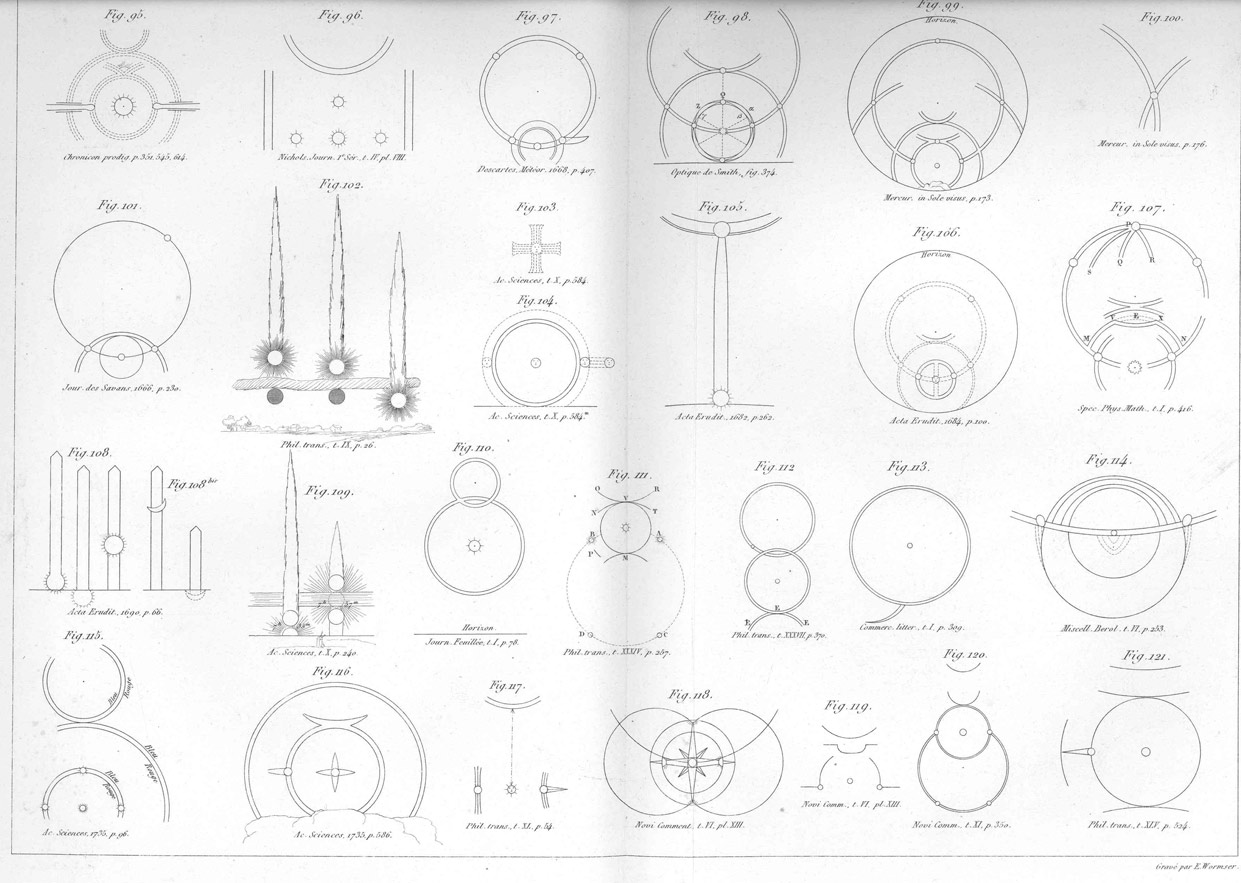
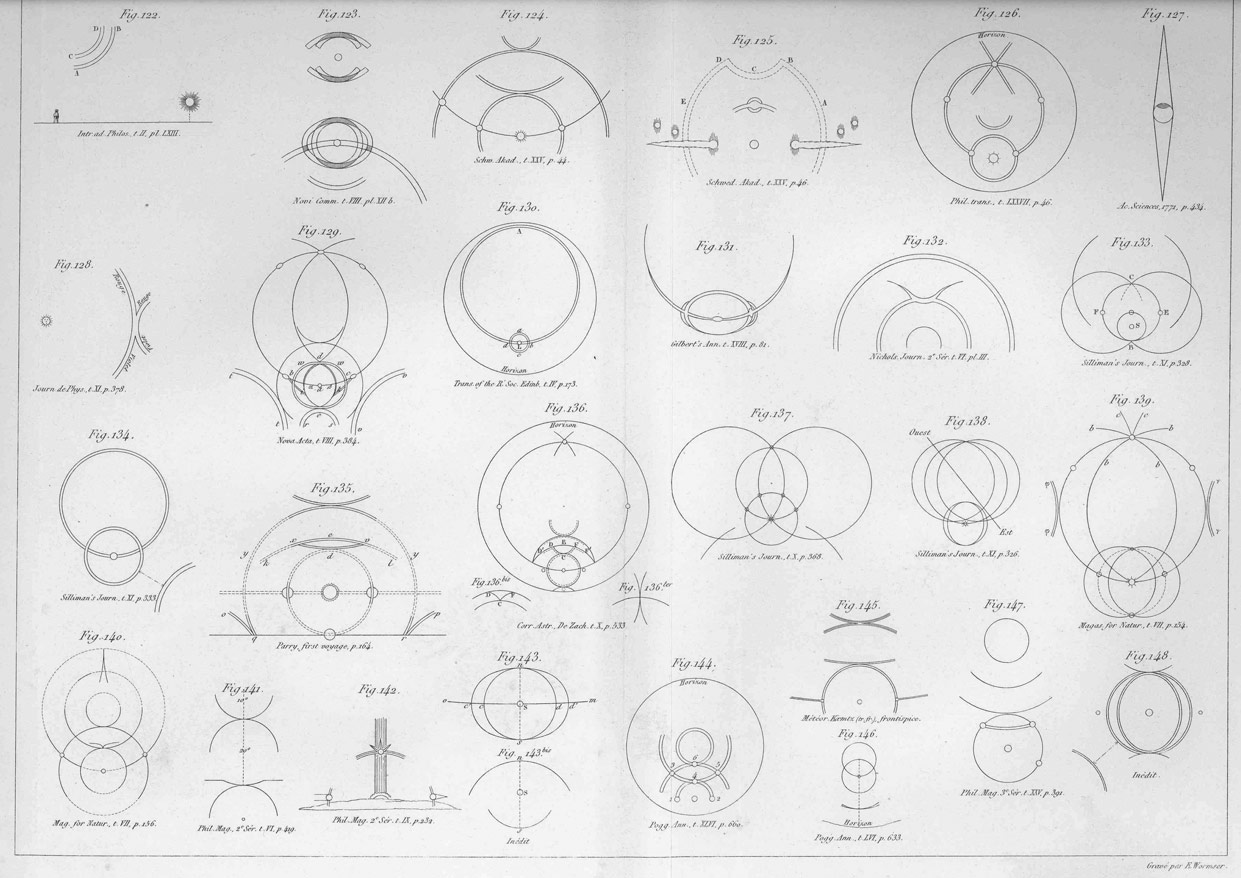
The almost 300 page book of halos, "Mémoire sur Les Halos et les Phénoménes Optiques qui les accompagnent", by Auguste Bravais, is available for download ( 1 ). The digital copy is given by Google. The book, which is from year 1847, starts from pdf page 209. In the end are figure tables which have not been reproduced well. They contain theoretical considerations, like crystals and raypaths but also displays re-drawn by Bravais. Better scans of the display tables are given ( 2 - 3 ).

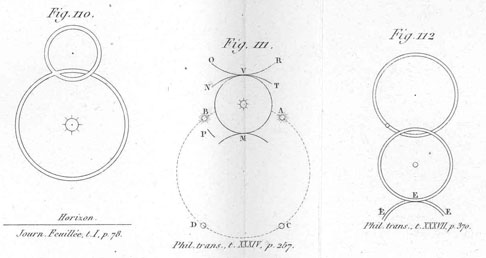
The displays in the image above are from the book. On the left is the observation by Feuillee, from which the observer name for 35° halo was derived.

In the document are also two other articles by Bravais. First one, starting from pdf page 87 is of various parhelia and second one on page 105 seems to be about fogbow.

2008. május 23., péntek

Wilson's 1911 sketch of a snow surface halo

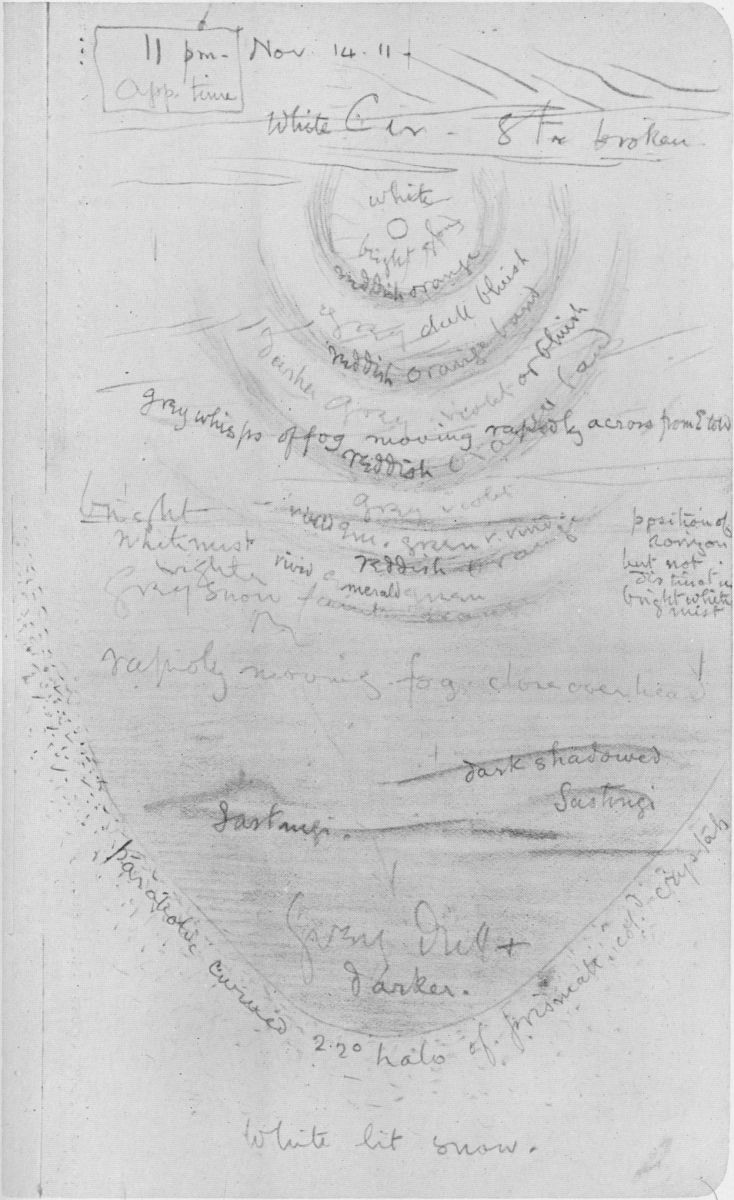
The sketch was made by Edward Adrian Wilson (1872-1912), the English polar explorer. He drew the observation on 14 November 1911 in Antarctica, a few months before he died in Scott’s final expedition. The drawing can be found in The Worst Journey in the World (1922), the memoires of Apsley Cherry-Garrard, a survivor of the team.

The sketch is not that easy to read, Wilson intended it for later use and re-working. From top to bottom, the notes in the drawing indicate that in the sky, there was white, broken cirrostratus ("white Cir. Str broken"), and the Moon was surrounded by a "bright glory". There were "gray whisps of fog moving rapidly across from E to W". Wilson also marks the "position of horizon" in the middle of the picture, which was covered in "bright white mist". In the lower third of the picture we can read "rapidly moving fog close overhead", and then at the very bottom of the sketch, on the "white lit snow" there is the "parabolic curved 22° halo of prismatic col. crystals", the inside of which is "darker".

In the note to Chapter XIV, we can read how the explorers used the snow surface halos for keeping the direction: "It is now that halos may be seen in the snow, almost reaching to your feet as you pull, and moving forward with you: we steered sometimes by keeping these halos at a certain angle to us."

Source: Project Gutenberg ( 1 )