2011. május 30., hétfő

New book on halos


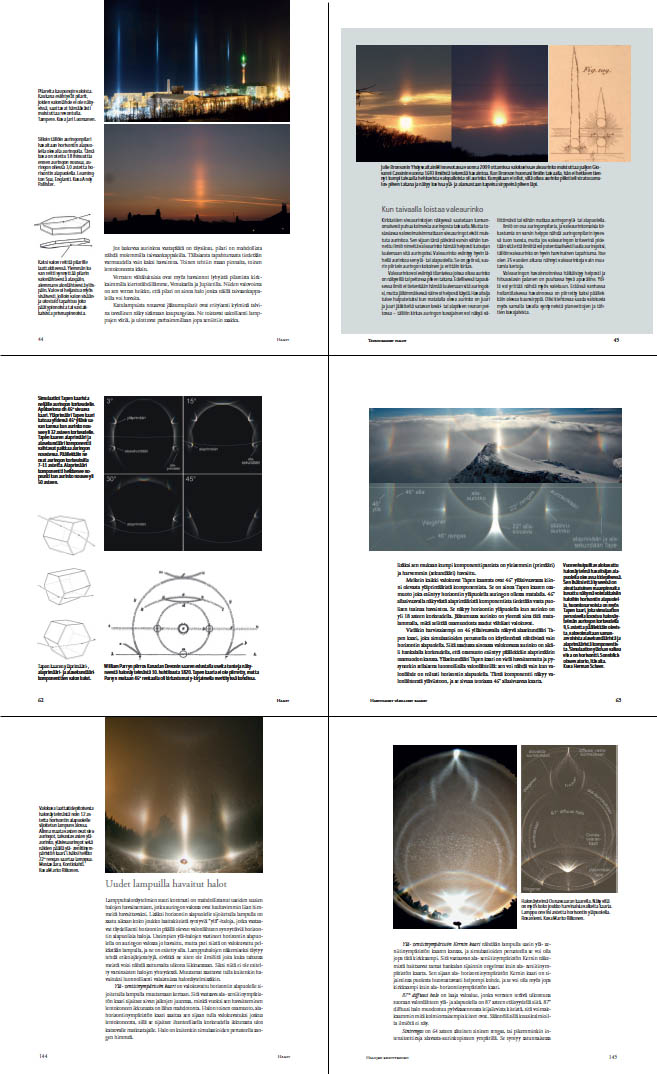
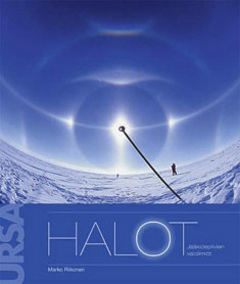
The Finnish Astronomical Association URSA has just published a new book on halos by Marko Riikonen. This book combines the latest halo science with stunning images from all around the world.

Spanning 168 pages, the book presents, illustrates and analyses all the known (and the less well known!) halo forms in great detail. In addition, the newly made discoveries and methodologies concerning spotlight displays are discussed in depth. Many historical displays are also included as a reference. Particular care has been put into preparing the beautiful computer simulations that are used to explain the ice crystal populations behind each display.

The variety of the images is striking and Riikonen has obviously spent a lot of time in finding great examples. Luckily the quality of printing matches these images: I have rarely, if ever, seen a print job this good. Even the faintest halos can be distinguisted in the images.

As Riikonen is a long-time expert in the field, the substance of the book is solid and provides everybody from beginners to experts with new insights about halo science. Being such a significant contribution to the field of atmospheric optics one can but hope for a quick release of an English language edition.

A few select pages can be previewed online (1). Publisher information (2).

Riikonen, Marko (2011) Halot. Jääkidepilvien valoilmiöt. [Halos. The optical phenomena of ice crystal clouds]. Tähtitieteellinen yhdistys URSA ry, Helsinki.

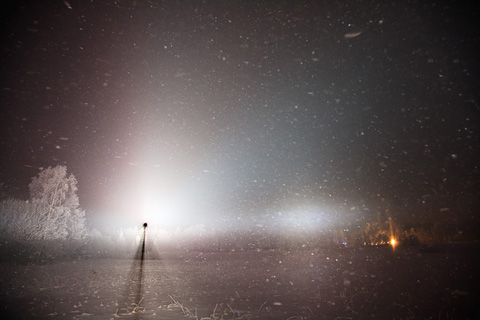
Liljequist superparhelia & a nucleation agent gun


This Liljequist superparhelia was observed in the spotlight beam on 5 January 2011. The lamp is about a degree or two below the horizon, thus giving the central stage to the Liljequist superparhelia. The Liljequist parhelia can be seen against the snowy ground below the superparhelia.

The halos were seen in diamond dust that was generated by my water ice nucleation agent gun operating ca. 1 kilometer away from the site of the observation. The nucleation agent gun can operate autonomously for hours since the water supply is automated. The temperatures varied between -22 and -27 degrees Celsius.

The image above shows some colour artefacts (the background sky is not even color) as we were also testing Riikonen latest HID lamp (Marko Riikonen accompanied me during this night) that has two high intensity discharge bulbs. Unfortunately we were only able to fire up one bulb. Two bulbs would have produced a more even beam in terms of colours and luminosity.

Full image gallery is available (1). It also contains a lengthier account on the evening.

The nucleation agent gun can be seen in action in a separate photo gallery (2).

Atmospheric optics meeting of 2011 in Finland


Finnish Atmospheric optics enthusiasts met on 27-29 May 2011 in the Artjärvi observation centre. The topics of the presentations varied from the latest scientifical results in NLC research and simulation of higher order rainbows to the polar expeditions and observations of optical phenomena in the 18th century. The full programme is available (<a href="http://www.ursa.fi/wiki/Ilmakeh

2011. május 21., szombat

Halos 20. May

[gallery columns="5" orderby="title"]

In the afternoon the clouds came. Parhelion was blindingly bright. I followed as the same cloud reached the 120° parhelion position and there was an intensity increase which soon attenuated. The last image shows two photos taken 88 seconds apart, the 120° parhelion is seen in the left photo, in the right photo the cloud has already moved further and the distant parhelion is no more seen. I think the best part of the cloud did not pass the 120° parhelion location, or it would have been brighter.

Day's halos:

  • 22° upper tangent arc

  • 22° halo (just a small patch in the second photo)

  • parhelia

  • pillar

  • circumznith arc

  • 120° parhelion

2011. május 2., hétfő

Sun pillar in Stratocumulus virga (and an attempt of fake sun), 1. May

[gallery link="file" columns="5"]

In the spring, when there is a break of cold air from north and snow showers develop in the daytime, it is good chances for sun pillar in the evening. This is because the snowing cumulonimbus start losing their power and reduce to stratocumulus with icy virga. And the virga of low and middle level clouds often consists of crystals that make decent pillars.

This is what happened on 1. May in Tampere. Above are some photos from the evening. There was also an attempt of fake sun, but for my criteria it was not quite there yet. These low sun pillars and fake suns are difficult to photograph because of the clipping of red. The fifth image (small thumbnail on the right) is a series of the fake sun attempt: the pillar below the sun in the beginning of the series was blindingly bright, even though I was watching with sun glasses (you need welding glass to observe these properly). In the end of the series the true sun is coming visible. The photos were given lowest white balance value possible and highest recovery value in Photoshop. That's how red clipping was gotten rid of. The downside for this realism is unrealistical blue photos. The leftside photo in the gallery on the second row is the same as the first in the blue series, but with more normal white balance values. There is red clipping that masks the true nature of the pillar / fake sun effect.