[gallery ids="1582,1581"]
So you want see all known halos? Then here is a list of the work ahead. As of now, there are 75 halos to catch and if we count also the components as separate halos then we have 94 halos. From the point of view of halo spotting, components are of course counted as separate entities. For example, 23° plate arc divides in upper and lower components, of which the lower component - although not necessarily rare as such - is nevertheless thus far exceedingly rarely observed.
We can add also to the numbers above the halos that appear solely on the snow surface. By doing that we have 77 / 96 halos. Notice that in the table there are also components (and one halo) that have not yet been observed in nature. These theoretical halos have not been included in the numbers above. More on these below.
For each halo in the table there is a frequency estimate. The table is for Finland and it is certainly not applicable to tropics, High Arctic or Antarctic. Even in the Middle Europe the frequencies seem to be different for some halos. Sure, the maximum sun and moon elevation encountered at different locations on Earth is of course a factor that affects the frequencies of some halos (for example, circumhorizon arc can not be seen in Finland because sun or moon never rises high enough) but mainly I am talking here of the differences that are caused by the properties or visibility of ice clouds.
The frequencies in the table are mostly given as a plain number (140, 7, 0.1, etc) indicating on how many days (sun) and nights (moon) a year the can halo be seen (surface or lamp light occurrences are not counted in these numbers). Or it is given as description (common, rare, etc) or a number of known observations (1 obs., ~10 obs. etc).
The plain number assumes a stationary observer who observers visually with a convex mirror never stacking any photos and never hunting the diamond dust halos from the snow guns. This observer won't see the additional rare halos in his photos that the stacking brings or experience the great diamond dust displays with some truly rare halos.
The descriptive estimate is for halos that have been only seen from an airplane or in diamond dust. It tells how common a certain halo is under these observing circumstances. Seeing them depends almost solely on how much one flies and hunts halos in the snow gun generated diamond dusts. If you do neither, you probably never see these halos. The subhorizon halos are easy to catch in diamond dust with a bright spotlight placed below horizon. This turns the halo sky upside down with subhorizon halos now visible above horizon.
For halos for which only very few observations are known, no estimate of the occurrence is made - instead given is the number of observations. I have used this when the number of observations does not exceed 10. Of course I may not know all the observations and there can be also differing opinions about some observations.
For some halos in the table - mostly components - there is no frequency estimate or number of observations. These are as of yet unobserved. Many of them probably stay that way, but nevertheless from these it is possible to find some prospects for discoveries. Often though, it seems, a new halo something totally unexpected - something for which the halo theory has been totally blind.
Naming of halos is an issue itself. For the well known halos I have followed a common practice. For the odd radius halos I have chosen the nomenclature used by Tape and Moilanen in their book. Then there are halos which have not been baptized in English yet. These are halos that have been discovered recently. In such cases I have given the Finnish name if such exists - the very latest finds are still unnamed. I will complement the table on these later on.
Some notes are given in the last column of the table. Halos that have been observed only in diamond dust and / or from airplane have been indicated, the "dd" meaning diamond dust. If there is a blank in the notes column for certain halo, it means it has been observed from the ground in ice clouds higher than diamond dust. For some halos, in addition to "dd" there is also "hc". This means that the halo is most likely in diamond dust, but has been documented also in high clouds. ""Lamp" tells that the halo has been observed with a bright spotlight - if no other light source is indicated, then this is the only method of observation. "Stacked" in the notes is to tell that the halo has been detected only from stacked images in certain situations, like in case of high clouds.
I emphasize again that the plain frequency numbers don't count the great diamond dusts from the snow guns. An observer who never hunts in these diamond dusts may never see some rare halos, such as the subanthelic arc or 44° parhelion. Also the numbers don't count what additional halos would appear in photos if stacking is employed. Many halos become much more common when photos are stacked. For example one can expect to see 35° halo visually in high clouds perhaps once or twice in 10 years, but with stacking it can be detected in odd radius displays at least once a year. Likewise, pyramid helic arc in high clouds is almost impossible to see visually, but stacking can bring it into light in displays with strong 23° plate arc.
Next I should write presentations of all these halos, because for many of them there is not really information in the internet. But that would be a huge job.
2013. december 3., kedd

2013. november 21., csütörtök
Subparhelic circle on snow surface
[gallery columns="4" ids="1543,1542,1538,1555"]
Subparhelic circle is traditionally seen from an airplane in ice clouds below. But it is exceedingly rare. A more productive way of observing subparhelic circle is in diamond dust using bright spotlight as a light source. A patch of subparhelic can be seen also on snow surface. Here I present such a case.
On snow surface subparhelic circle appears as crystal glitter on the sides of observer's head shadow. This is shown in the first two photos, which are different versions of the same peak hold stacked image of 46 frames. A single photo (third image) is not as convincing - snow surface halos have tendency to weaken markedly in single photos which is why stacking is good idea to bring them to the level of visual impression or even exceed it. In the first image the effect is somewhat on par with the visual impression.
The formation of subparhelic circle on snow surface requires two things: ample of sectored plates and strong wind. A dense snowfall of sectored plates in still air is not enough, because crystals falling the snow surface will orient themselves according to the irregularities of the snow surface - that is, in more or less random fashion. However, if the sectored plate fall is associated with strong wind, then the crystals are oriented on the snow surface with their large basal faces in more or less horizontal orientation to minimize the air resistance. This is the crystal orientation required for the formation of subparhelic circle.
Meeting these two requirements seems not easy. I saw subparhelic circle on snow surface first time in Canada's Resolute Bay on 15th March 1999. A couple of weeks later there was another appearance, indicating that the effect may not be that rare in the High Arctic. But I never went back and was from then on trying to see the effect here in Finland. On 15th March 2013 - exactly 14 years after the first observation - there was finally a success. The photos above are from that day when subparhelic circle appeared here in Joensuu.
I first saw a wide sun pillar on the snow surface, as shown by the fourth image. Because in Resolute the subparhelic circle was associated with similar pillar, I knew that in the opposite direction there must be subparhelic circle. The subparhelic circle did not seem completely symmetrical, the right side seemed to curve down more than the left side. The stacked images seem to confirm this slight asymmetry. This is probably due to crystals that had a slight tendency to point their tilted basal face to certain azimuthal direction. One can imagine this happening with a wind blowing from one direction.
In computer halo simulations that use simple hexagons subparhelic circle appears from raypaths that involve reflections inside the crystal. While in airborne crystals subparhelic circle is most likely formed by such raypaths, this probably can not happen in the sectored plates that form the subparhelic circle on snow surface. My suspicion is that in the latter case the subparhelic circle is formed from reflections on the external surface of these crystals. Sectored plates have ridges and depressions that form faces in 90 degree angles on their surface and a reflection from these faces produces subparhelic circle opposite to the sun in crystals having plate orientation. According to calculations by Lauri Kangas, external reflections produce three times fainter effect than what would appear from internal reflections in simple hexagons.
Probably the best places to see subparhelic circle on snow surface are in the High Arctic and Antarctic where strong winds are commonplace and presumably abundant snowfalls of sectored plates are not rare either. In more moderate climates treeless mountain tops could be most productive. In Resolute Bay strong wind had actually collected the sectored plates in large horizontal sheets of crystals. In the Joensuu case shown here, the crystals seemed to be in isolation.
So, next time you are surrounded by sunlit snow, look around. If there is crystal glitter, usually it is uniformly distributed, perhaps showing some circular halos. But if there is pronounced glitter in the form a wide pillar in the sun direction and not much at all glitter elsewhere, turn around and look at your shadow. You will most likely see the glitter of subparhelic circle emanating from the sides of you head shadow.
2012. április 9., hétfő
Odd radius halo - 2 April
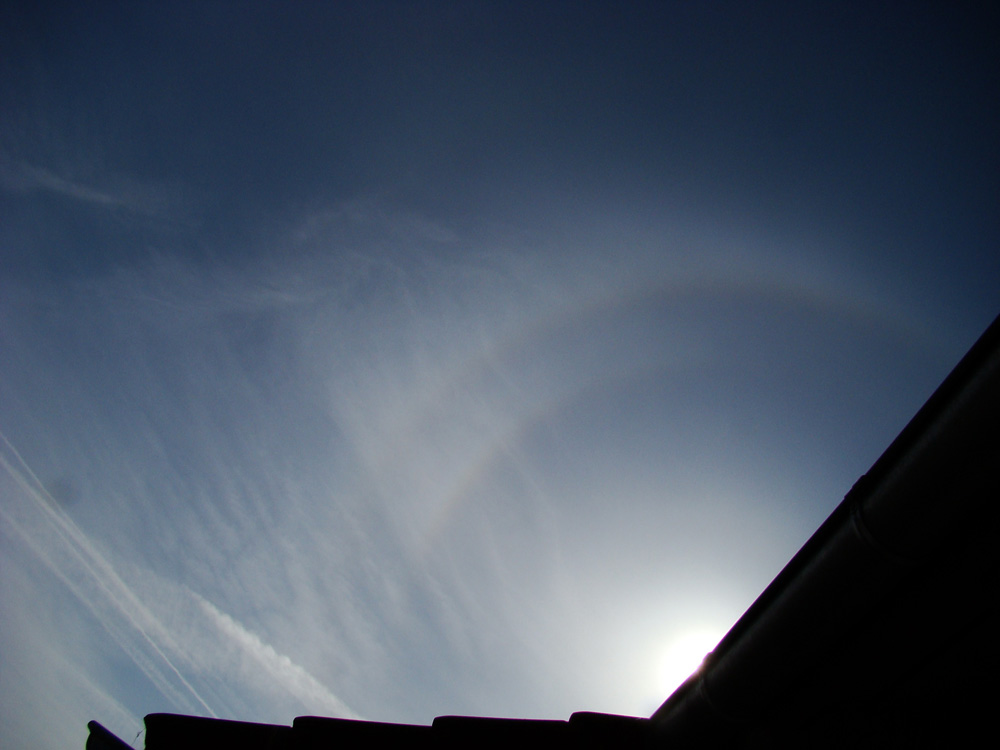
Veit has sent this odd radius halo from southern Germany. He took the photos on 2 April 2012 at 10:48 CEST. More of his halo images cane be viewed in his Panoramio gallery ( 1 )
2012. január 27., péntek
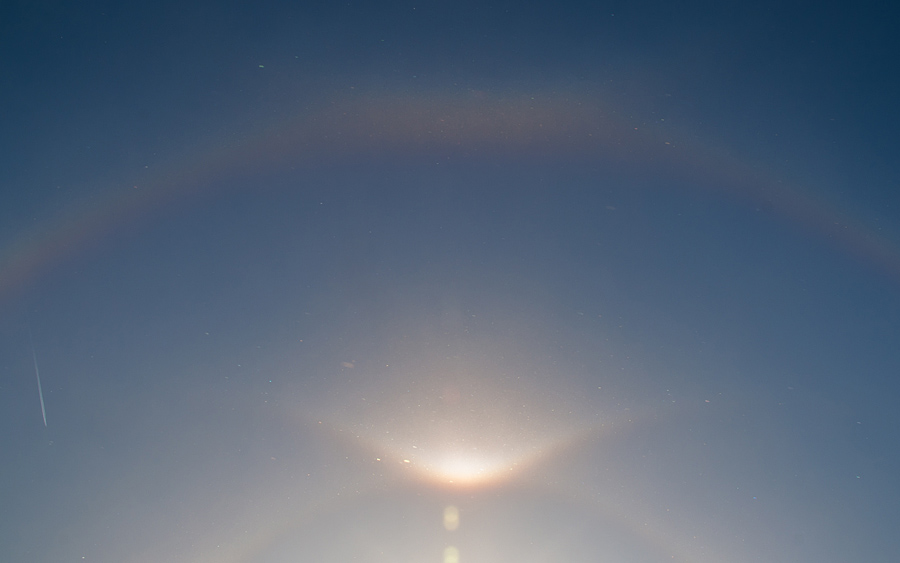
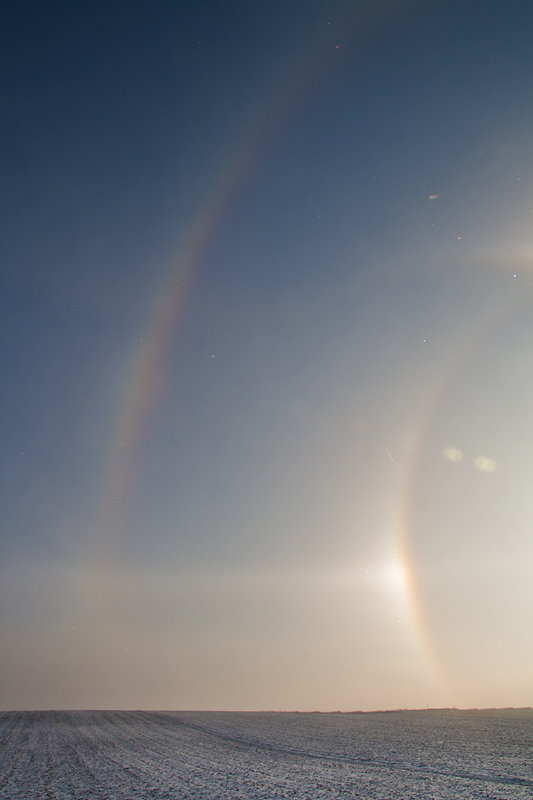
Display from Achsheim

The day before it was cloudy and it was snowing a little bit, during the following night there weren’t any clouds and in the morning there was „normal“ fog. The minimum temperature in the night was about
5 °C below zero.
I don’t know when the halo display began, because when I reached this region full of ice crystals it existed already. And it still existed when I left the region (10:00 a.m). I took photos of it from about 9:25 until 10:00 a.m (CET).
You can see well the 22° halo, sun dogs, supralateral arc, the upper tangent arc, circumzenithal arc, tape arc, infralateral arc and last but not least the Moilanen’s arc. All phenomenas were seen all the time I was there. ( 1 - 2 - 3 )

Daniel Eggert
2011. október 22., szombat
Helic and Tape arc in Cirrus

It started at 14.25 CET (15.25 CEST) with circumzenithal and supralateral arc. During the following minutes, also the upper tangent arc, a bright Parry arc and the 22°-halo appeared, followed by both sundogs and a faint upper circular Lowitz arc on the left side. ( 1 )
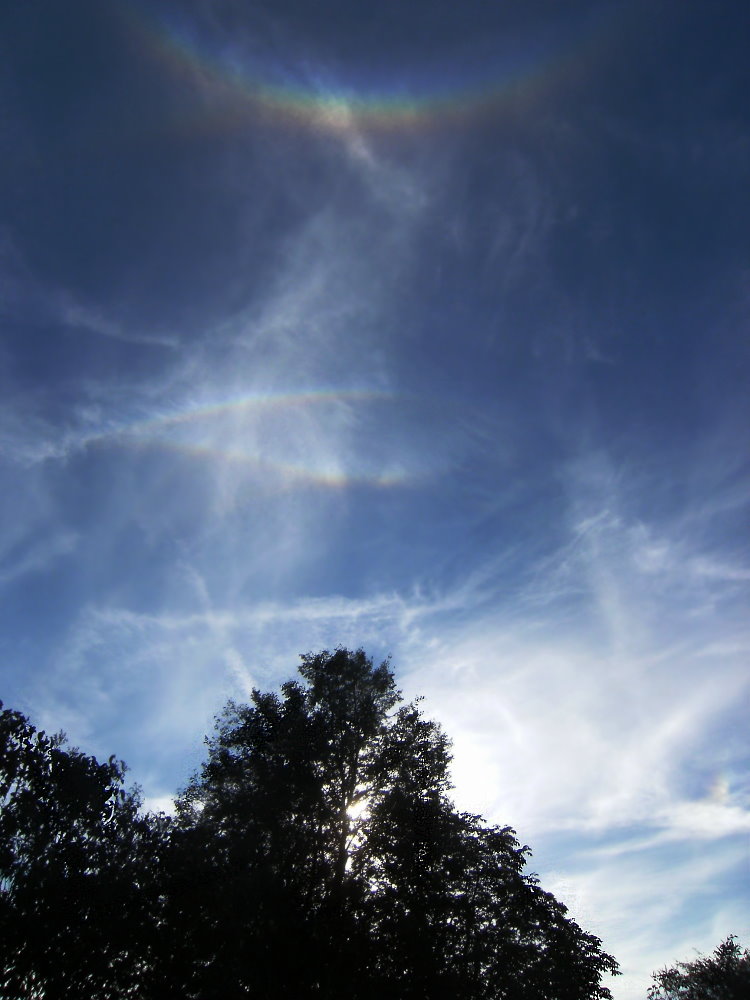
At 14.50 CET, I noticed a conspicuous white arc, forming a circle around the zenith together with the CZA. A closer look showed that this circle was not really circular, but rather had the shape of an American football.
This white arc grew longer and longer, an as ist passed the supralateral arc, it turned out to be the heliac arc, clearly visible in thin cirrus clouds.
At 14.55 CET, also the upper left Tape arc appeared as a bright colourful spot on the supralateral arc. At the same time, the left part of the Parry arc grew very long, almost reaching the supralateral arc, while its upper part faded away. ( 2 )
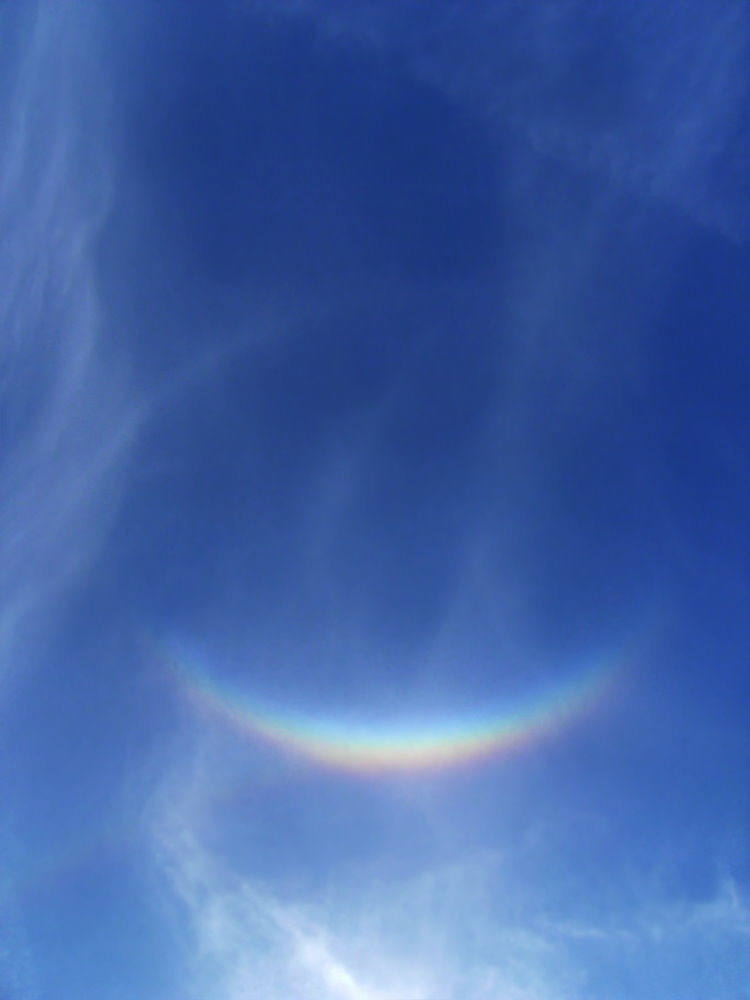
After 15.00 CET, the halo display slowly vanished, but before it faded away, left Lowitz arc was visible for about 10 minutes, as well as a very bright part of the parhelic circle. The display ended at 15.25 CET, having showed 10 different types of haloes with up to 8 being visible at the same time.
Peter Krämer, Bochum, Germany
2011. október 17., hétfő
Subanthelion and diffuse subanthelic arcs
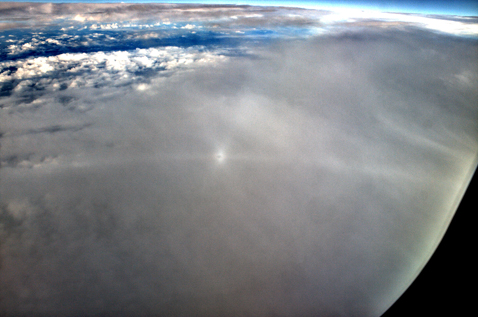

Then a short time later subparhelic circle and diffused arcs appeared too for about 1 minute ( 2 ).

Later on the flight, I could observe some brightening in the subanthelic area but not as conspicuous as in the beginning of the flight
Nicolas Lefaudeux
2011. szeptember 10., szombat
Plate Arcs from Japan

These pyramidal crystal halos were observed by Anthelene over Sakaiminato city in West Japan. The most interesting features of this high cloud display are the 9°, 20°and 24° plate arcs. Marko Riikonen has made a simulation with HaloPoint2.0 ( 1 ), according to him, the 20° plate arc had been photographed only once or twice in high clouds before. More of Anthelene's images can be seen on her website: http://bluemomenttime.blog89.fc2.com/blog-entry-442.html

Feliratkozás:
Bejegyzések (Atom)