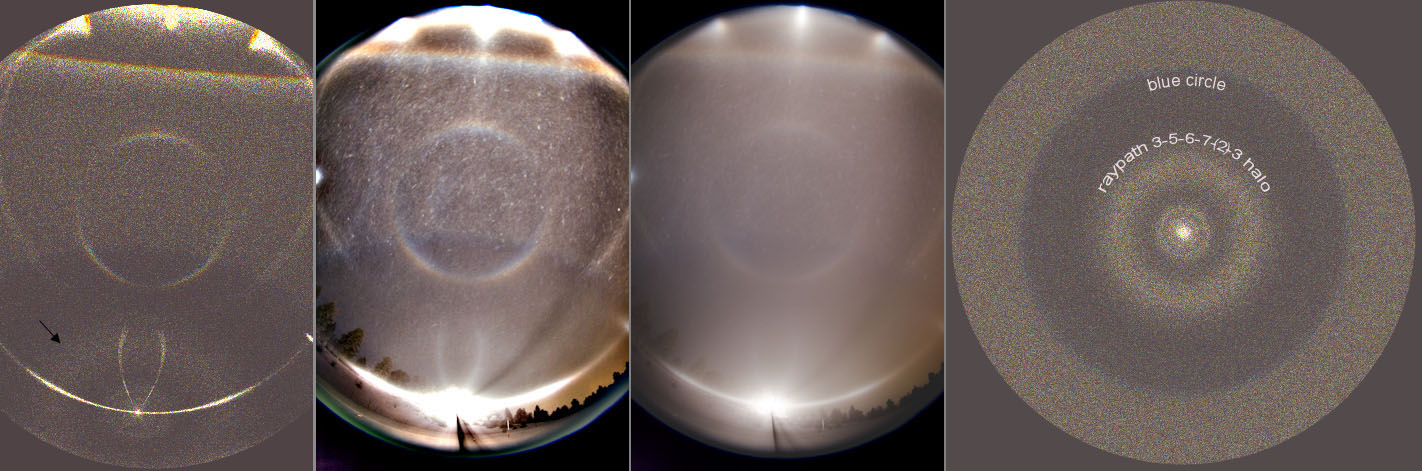
Two consecutive photos of the 7/8 December display contain reflected Lowitz arcs. The large image above is a stack of these two photos, the small upper image being heavily unsharp masked version of it. Reflected Lowitz arc is marked with an arrow in the small image.
The moment of reflected Lowitz arcs was short lasting: two photos showing them were taken within 35 seconds. Photos taken immediately before or after do not contain them. The lower small photo is timed one minute before their appearance, the halo composition being otherwise similar except for the reflected Lowitz arcs.
In these photos present is also upper sunvex Parry arc, which was missing from the display phase shown in my previous postings.
2008. december 21., vasárnap
Lampside of 7/8 December
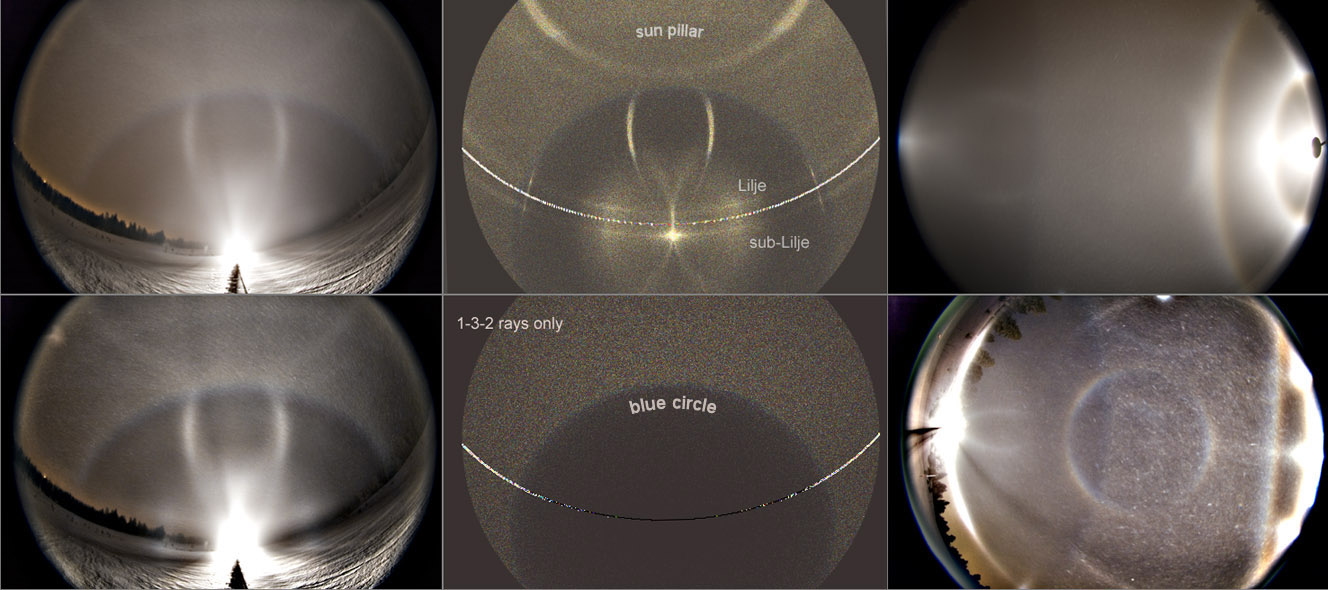
Here are photos taken towards the lamp. They were taken at the time when blue circle was strong on the opposite side of the sky. The upper ones are single images, exposure times 2 and 15 seconds. The lower images are stacked from a couple of frames with 1 to 2 seconds exposures.
Simulations say the lamp elevation is pretty close to 5 degrees. Images show upper sunvex Parry but no suncave Parry. Low lamp elevation may alone exclude suncave Parry, but as it is seen in some other photos, changes in crystal prism face ratios must be responsible for this difference. Best simulations of these photos are obtained with Parry crystals that are towards a triangular shape.
2008. december 19., péntek
Another Bouguer's halo
These three single photos are from different stages of the 7/8 December display in Rovaniemi. They all show Bouguer's halo, i.e. fogbow together with halos. But in reality halos and fogbow were seen mainly separately, in swiftly passing ice and water clouds. 30 seconds exposure has captured them nicely in the same frame.
2008. december 15., hétfő
Circular subanthelic halo from 3-5-6-7-(2)-3 raypath
The subhorizon photos of 7/8 December show what seems to be part of a diffuse circular halo surrounding the subanthelic point. Similar effect can be simulated with random oriented crystals (arrow in the simulation on the left). It arises from raypaths 3-5-6-7-3 and 3-5-6-7-2-3, which in plate crystals make respectively the Liljequist and sub-Liljequist parhelia.
The simulation on the right provides a 180 degree view of halos from random orientation centered around the subanthelic point. The bright dot is the subanthelion. The narrow small radius halo is from raypath that I have not checked. It seems to disappear if the crystals deviate even a little from regular hexagonal shape. Then there is the diffuse 3-5-6-7-(2)-3 subanthelic halo and blue circle.
Finally, a note on the Parry crystals used in the simulation on the left: no triangles this time, regular h/d 1 hexagons were used. Simulations with Jukka Ruoskanen's software.
Blue circle
What happens when tilts of the crystals that make blue spot increase? The blue spot starts to elongate vertically, forming eventually a blue circle. It is shown in these images that were taken on 7/8 December night in Rovaniemi.
Simulations in the middle used plate crystal tilts of 90 degrees to make blue circle. In the lower simulation the 1-3-2 rays responsible for blue circle are shown (probably also 3-1-6 rays contributed, but they were not included).
Blue circle is a circle of about 70 degrees radius around the subanthelic point. The intersection of parhelic circle and blue circle is the location of the blue spot. This gives us a practical insight on why blue spot changes position and elongates with increasing sun elevation ( 1 ).
Also other halos are seen in the photos. Some of these are named in the simulations, which are made with Jukka Ruoskanen's software.
2008. december 12., péntek
Bouguer's halo
On the 5th December in Nivala water fog lay still in the air at -7 C temperature. So conditions were perfect for testing the halo gun which sprays water-kaoline mixture to initiate ice nucleation ( 1 ). The spray was carried to nearby field where it started rapid transformation of fog into diamond dust. In the beginning a fogbow was present at the same time with halos ( 2 ) but as ice nucleation proceeded, only column crystal halo display was seen in the spotlight beam ( 3 ).
A couple of old observations depict an apparent fogbow observed simultaneously with halos. In such a situations it has been called as Bouguer's halo. The observation from which the name originates, however, is without halos. It was made in Peruvian Andes in 1735 by explorers Pierre Bouguer and Antonio de Ulloa. The drawing made by Ulloa features also glory ( 4 ).
Seeing Bouguer's halo, i.e. fogbow together with halos, is not easy, because ice crystals and fog droplets tend not to occur together in suitable mixture. And even if the mixture is right, fog may be too thick for sun or moon to shine through. In that situation a bright spotlight gives an advantage.
2008. december 11., csütörtök
A halo from Parry oriented crystals with raypath 4-8-1
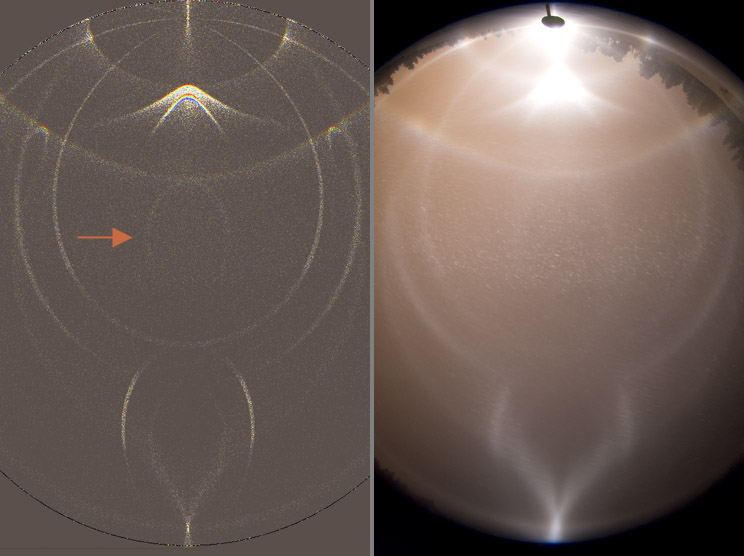
The photo is from last weekends major display. The arrow in the accompanying simulation (Jukka Ruoskanen's program) points to a halo that arises from Parry crystals with raypath 4-8-1 (where 3 is upper face). This arc was found from photos previous winter ( 1 ). Simulations showed then that triangular Parry crystals made it. Same applies to this new case: Parry halos in the display were simulated successfully only with triangular crystals.
Feliratkozás:
Bejegyzések (Atom)