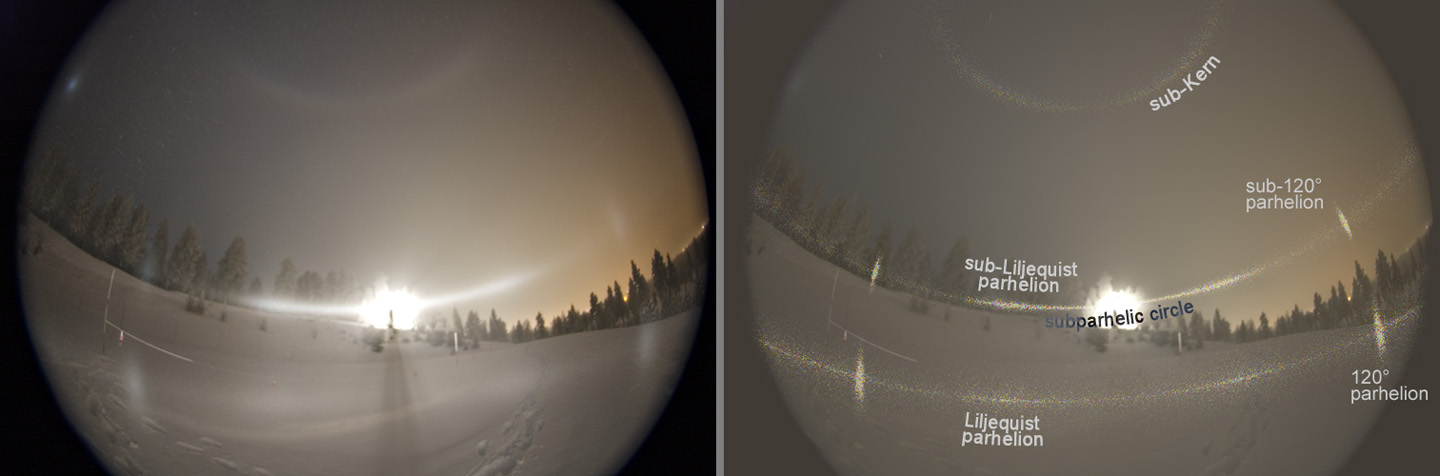
On the night of 7/8 December in Rovaniemi water fog was nucleated to diamond dust by snow machines, and a major display was observed in a spotlight beam for several hours. The photo above is from the end stage when plates dominated.
The lamp is downhill below the horizon (about 11.5 degrees), which shifts subhorizon halos above the horizon. Halos are named in the simulation which is made with Jukka Ruoskanen's program. Sub-Kern and sub-120° parhelia have not been documented before. By other means these are difficult to see. One needs to sit in an airplane which happens to pass through a high quality crystal cloud and sub-Kern is also located so low that one probably is not able be view it from small airplane window.
Crystals used in the simulation were plates which prism faces were allowed to variate freely in size within some limits. This produced the rather uniform stretch of subparhelic circle where sub-Liljequist parhelia are becoming hard to distinguish. Had there been solely regular hexagons in the air, the sub-Liljequist parhelia would have been better defined.
There was also circumnadir arc, which is another new feature. Les Cowley ( 1 ) has more on this and other subhorizon halos in the display.
2008. december 9., kedd
2008. december 6., szombat
Reflected lower sunvex Parry behaviour
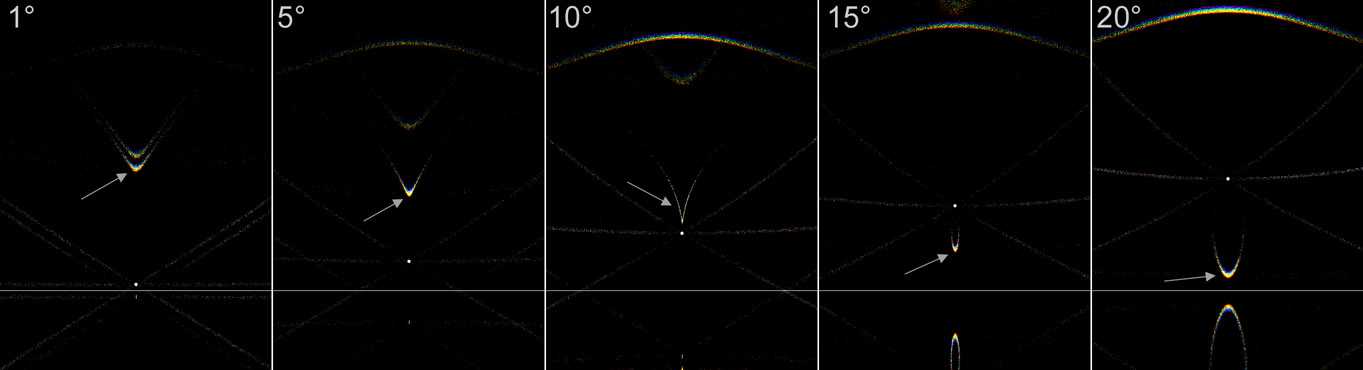
To supplement Les's posting, here is the behaviour of the reflected Parry as a function of sun elevation. At sun elevations higher than about 11 degrees, the halo arc is below the sun. The halo is perhaps easiest understood by thinking of it as a Parry arc of the subsun. At the solar elevations given in these simulations, it stays all the time at 22 degrees above the subsun. So if you know solar elevation, you know also where it is located relative to the sun.
In simulations for 15 and 20 degrees sun elevation also the normal lower sunvex Parry is seen, being as much below the horizon as the reflected Parry is above the horizon. Simulations are made with Jukka Ruoskanen's software.
2008. december 5., péntek
A peculiar halo on 6 November in Rovaniemi
In the image on the left is Moilanen arc among other halos. On the right is similar looking halo (arrow), but its V is more pointed and it is also closer to the sun, about 7 degrees above it. These are stacked images, the inset image is a single frame showing the same arc (and also a weak Moilanen arc above it).
This halo seems to be what could be called a "reflected lower sunvex Parry arc". It was Walt Tape who suggested this kind of explanation for the arc. I will later add a post with simulations, crystal figures and raypaths. Pictures of the halo were published today in Tähdet ja avaruus magazine in Finland.
*** addition 5 December: see the upcoming posting on Les Cowley's site ( 1 ), which lights up the formation of this arc ***
2008. december 4., csütörtök
Lascar display V
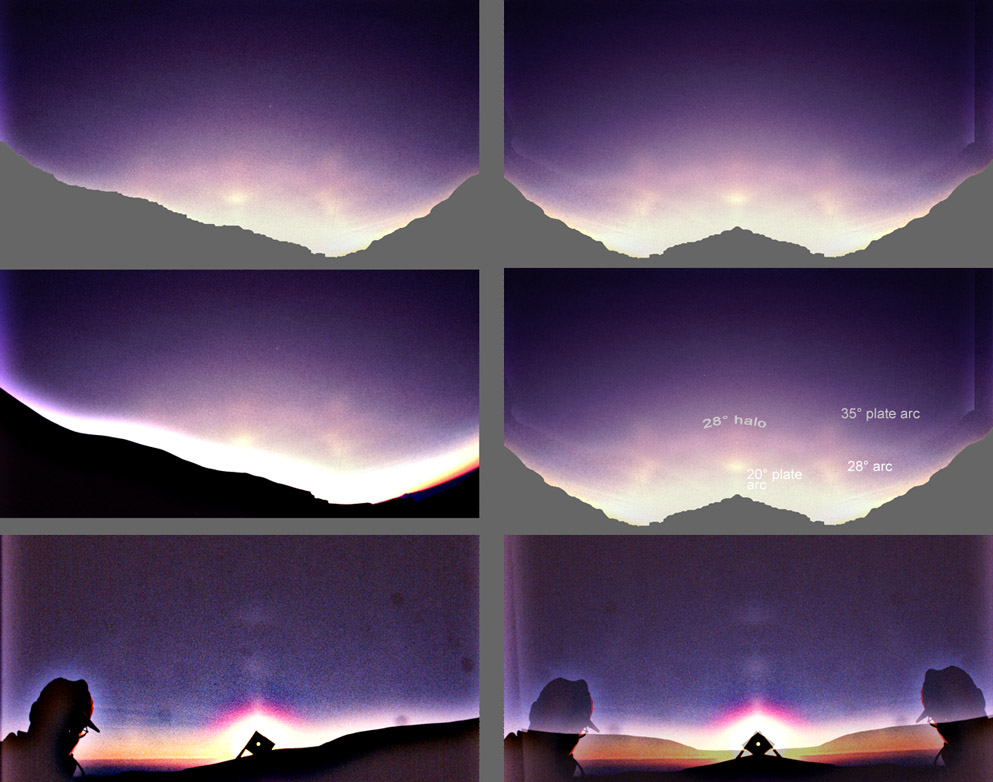
For the very lowest sun elevations there are only two photos, both shown here. Four uppermost images are versions of the same photo, which was the last one taken that day. Because halos have turned reddish, I suspect the sun was already below horizon.
Again a new feature has appeared, the 35° plate arcs. Others are familiar from previous postings.
To avoid wash-out from unsharp masking, ground was removed. For comparison, in the image on the middle left, the ground has not been removed. Same amount of unsharp mask and levels has been applied to both versions.
Photos at the bottom are from 1.6 degrees sun elevation (not to scale with upper photos). Two arcs directly above the sun are 20° upper plate arc and "Moilanen arc". From this slide the latter was measured to be 12 degrees from the sun.
2008. december 3., szerda
Lascar display IV
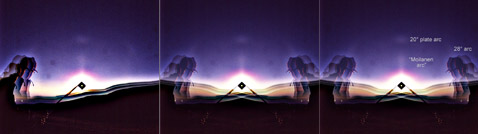
Now the sun elevation at Lascar is 2-3 degrees. The image is four frame stack. 20° upper plate arc is well visible. New feature, "Moilanen arc", has appeared. We observed it visually, it was V-shaped, not like the light mass seen in this photo. Photographing this arc was difficult, because it appeared and disappeared in seconds intervals. Measurements from two slides placed the arc at 10.5° from the sun, which is less than for Moilanen arc. But of course there is uncertainty in that value.
Lascar display III
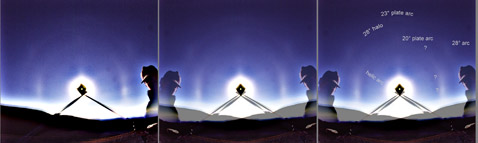
Continuing the Lascar halos tour. This image gives situation for sun elevation range of 11° to 9°. Image is stacked from four photos and also mirrored version is provided. 23° plate arc is already disappearing high up above the sun, but 20° upper plate arc on the other hand is appearing.
10 years ago we simulated the display with octahedral crystals of cubic ice and traditional pydamidal crystals. Octahedral crystal gives halos only at 28° and 19° from the sun. It was a good candidate for simulating because many features in photos from different solar elevations fell in place with it.
Among other things these simulations predicted that the 20° upper plate arc would be actually composed of two arcs, the other one being 19° upper arc... But there are still too many unexplained features in the display to trust our model, one being the fake 18° plate arcs.
2008. december 2., kedd
Lascar display II
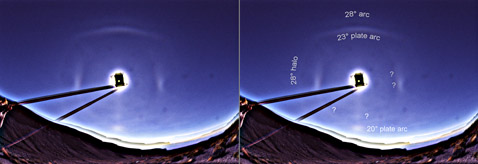
Another phase of the Lascar display. Three photos are stacked from sun elevation range of about 32° to 30°. Familiar halos are 23° and 20° plate arcs. Other halos are not so familiar.
Feliratkozás:
Bejegyzések (Atom)